RUNNER: JAMES_EARL_M
CLASS: AI_AUTOMATION_VA
LOC: MALATE.MANILA.PH
TOOLS: N8N · ZAPIER · CLAUDE
BUILD: v5.0
I build AI workflows that replace repetitive work — n8n pipelines, Zapier automations, Claude-powered agents, and Notion systems. Clients save 10–40 hours a week. Based in Manila, working globally.
Why Hire James?
Hiring James means your team stops doing repetitive work manually. He maps your process, picks the right tools, builds the automation, and hands it over — running and documented.
He's shipped a production-grade AI support router in n8n (16 nodes, 3 AI providers, circuit-breaker resilience), a React + Supabase booking app, and an offline Flutter AI assistant — all from scratch. He doesn't just configure tools, he engineers systems.

What I Automate For You
These are the exact workflows I build for clients. Each one replaces hours of manual work with a system that runs itself.
About
James Earl
I'm James Earl Medrano, a BS IT graduate from Pamantasan ng Lungsod ng Maynila with expertise spanning AI operations, IT infrastructure, and financial technology.
My career spans cybersecurity environments, international financial IT operations, and cutting-edge LLM development — a uniquely versatile skill set for modern tech roles.
Driven by the intersection of AI and practical IT — building systems that are both intelligent and reliable, from Manila to wherever the work takes me.
📌 Current status: Left Innodata Knowledge Services in May 2026 after contract completion. Actively interviewing for AI operations, LLM, and IT roles. Available to start immediately.
Work Experience
- Engineered and iterated on 200+ prompt templates weekly, improving LLM output accuracy and reducing hallucinations flagged during QA cycles.
- Delivered high-quality data annotation and side-by-side model comparisons for supervised fine-tuning pipelines used in production LLM training.
- Identified and documented model vulnerabilities during adversarial testing, with findings directly incorporated into model behavior improvements.
- Maintained top-tier annotation quality scores across all evaluation batches, consistently meeting client accuracy benchmarks.
- Resolved IT-driven cases for an international credit card company's Asia-Pacific operations, handling sensitive financial data for thousands of cardholders.
- Executed user account security actions (tracing, freezing, data deletion) in compliance with data privacy regulations, reducing exposure risk for compromised accounts.
- Built Power BI dashboards and Advanced Excel reports that surfaced operational trends, adopted by the team for weekly performance reviews.
- Maintained and updated CRM records to ensure audit-ready data privacy compliance across all case resolutions.
- Deployed and configured end-to-end secure environments — workstations, POS systems, servers, and firewalls — for enterprise clients in Makati's CBD.
- Diagnosed and resolved hardware and software incidents with fast turnaround, directly reducing client downtime and escalations.
- Authored technical documentation and troubleshooting runbooks that standardized procedures across the support team, cutting repeat issue resolution time.
Ongoing
Builds
A full-stack booking platform for tennis courts across Metro Manila. Browse 18 real courts on an interactive map, book a 1-hour slot, and get AI-powered playing tips, smart price alerts, and personalized court recommendations — all in Filipino or English.
A player opens the app, browses or searches courts by city, surface, or distance, taps a court to see live time-slot availability, picks a date and hour, adds optional equipment, then confirms the booking — all backed by Supabase auth and row-level security so each user only ever sees and manages their own reservations.
// Colors pulled directly from the live deployed app, not approximated
The hardest part wasn't the tech — it was designing for real-world messiness: courts with inconsistent data, users who book then no-show, and a map that needs to feel fast on low-end Android devices. I learned that Supabase row-level security needs to be planned from day one (retrofitting it is painful), and that shipping a real live demo beats a perfect prototype every time. I'd add server-side caching for court availability next.
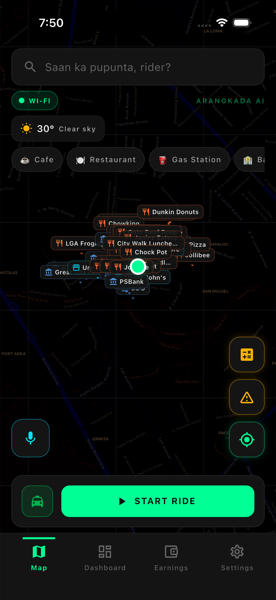
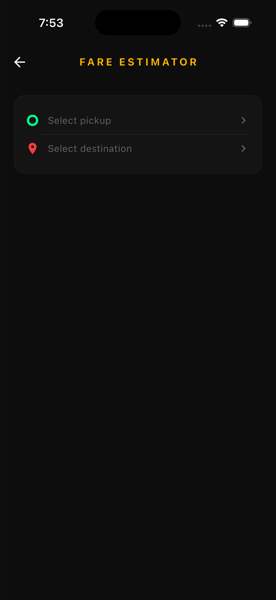
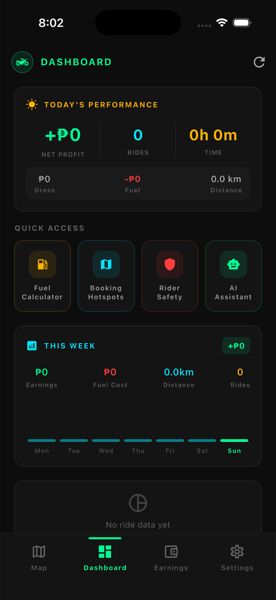
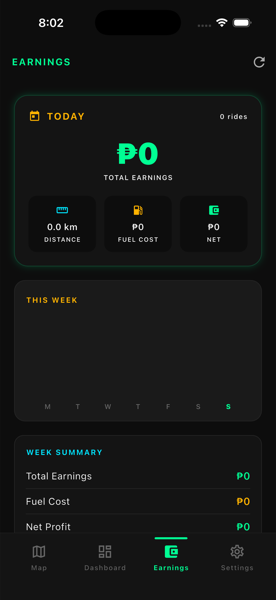
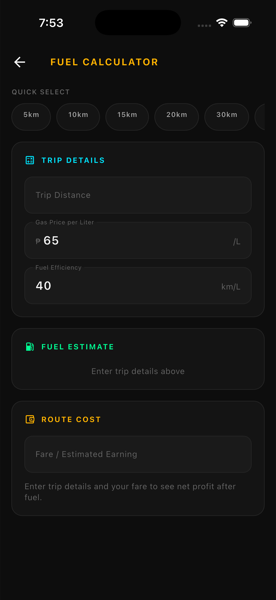
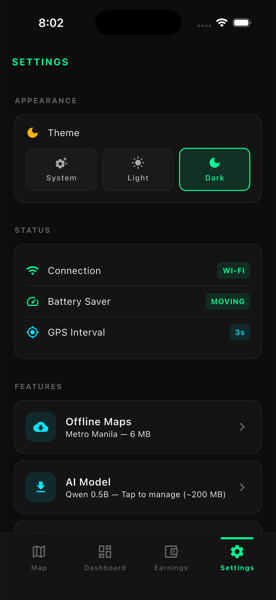
A Flutter navigation app built for Filipino motorcycle riders on Grab, Angkas, FoodPanda, JoyRide, MoveIt, and Lalamove — fully offline-capable maps, a 3-tier AI assistant, hands-free voice commands, a trip-worth fare estimator, and live flood alerts, all built on a ₱0 budget using free and open-source tools.
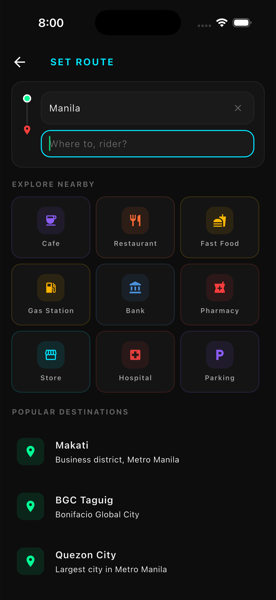
A rider opens the app to a live map with weather and flood markers, then searches a destination or taps the mic for a voice command. From there it's turn-by-turn navigation with flood-zone warnings, with the AI assistant on hand for anything about routes, traffic rules, or earnings — and the fare estimator ready before accepting a trip, to confirm it's actually worth taking.
// Colors pulled directly from malate_colors.dart in the real source code
Building a 3-tier AI fallback chain from scratch taught me that graceful degradation is a first-class feature, not an afterthought. Compressing 2.1GB of offline map data to 280MB required deep work on tile pyramid math and SQLite optimization — skills I didn't expect to need for an AI project. The biggest lesson: users in low-signal areas don't care about AI sophistication, they care about reliability. That constraint made the architecture stronger.
Arangkada AI
An offline-first AI co-pilot for Filipino motorcycle ride-hailing riders — built solo on a ₱0 budget, with a three-tier AI brain that keeps answering even with no signal, in the rider’s own Taglish.
Motorcycle ride-hailing riders work long hours on thin margins — yet the tools they use are generic, English-first, and useless the moment the mobile signal drops (which, on Metro Manila roads, is often). There was no single app that could tell a rider whether a trip is even worth taking, track real earnings against fuel cost, warn about floods and checkpoints, and answer questions in the language they actually speak — all without burning data.
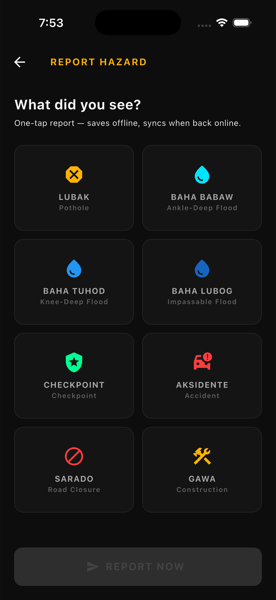
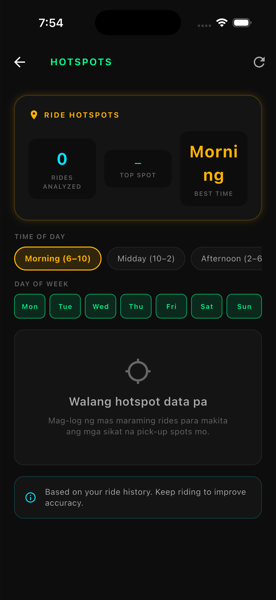
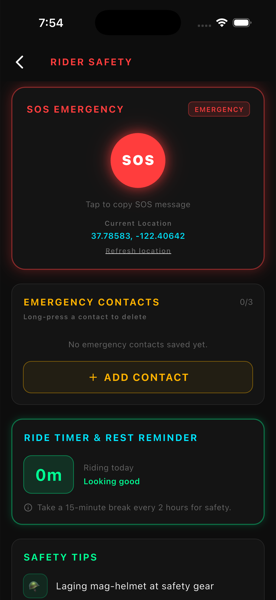
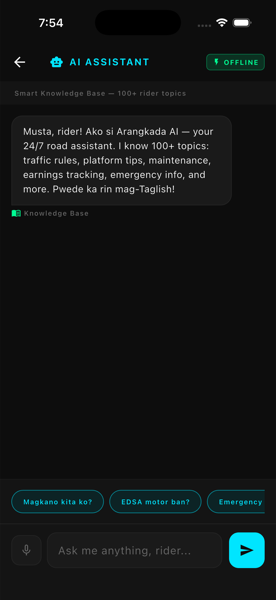
One Flutter app that puts the rider’s whole workday in their pocket and assumes the connection will fail. A live map with weather, a SULIT / PUWEDE NA / LUGI fare verdict before they commit to a trip, earnings & fuel tracking, one-tap hazard reporting that syncs when back online, ride-history hotspot analysis, one-tap SOS safety — and an AI assistant that routes each question to the cheapest tier that can answer it, falling all the way back to a model running on the phone itself.
This isn’t tool-configuration — it’s end-to-end product engineering with applied AI: model routing, on-device inference, offline sync, and localization, shipped as a 15-screen, ~14.5K-line app by one person for zero budget. The same three-tier routing pattern — knowledge base → cloud LLM → local fallback — is exactly how I design cost-aware AI automations for clients.
Arangkada AI — See It In Action
Real screens from the running app, plus a screen-recorded demo. Every shot below is the actual build — no mockups, no placeholders.
Core Skills
Try My Work Right Now
Don't take my word for it — describe any business problem below and get a real Claude-powered automation blueprint in seconds. This is the same kind of system I build for clients.
Real Numbers, Real Work
Every number below comes from actual projects — not estimates, not goals.
engineered at Innodata
automated per week
built & shipped
integrated in prod
workflows shipped
via smart routing
in prod pipeline
2 years of work
What 3 Jobs Taught Me
Every role left me with a principle I still use. Here they are, unfiltered.
Certifications & Training
VA clients hire by tool familiarity. Here's the documented proof behind the skills.
Education
Graduate
2025
Information Technology
Workflows I've Built
Production-grade n8n automations with real cost-routing logic, circuit-breaker resilience, and multi-provider LLM orchestration. Not tutorials — actual systems built from scratch.
An enterprise-grade customer support pipeline that automatically triages incoming emails, routes them to the cheapest AI model that can handle them, and fails over to a backup provider if the primary goes down — all without human intervention.
Every inbound email hits Claude Haiku first. It scores sentiment (calm/frustrated/angry/panicked), urgency (critical→low), and structural complexity. Cost: fractions of a cent.
Simple tickets (billing questions, plan inquiries) → Haiku at $1/M tokens. Complex/escalated tickets (API outages, multi-issue debugging) → Sonnet at $3/M tokens. Saves ~67% vs always-premium.
429 rate limits, 529 overloads, 5xx errors → automatic failover to OpenAI backup. Hard failures (400/401 auth) → dead-letter queue with alert. Zero dropped tickets.
always-premium
orchestrated
supported
on failure
passing
The hardest engineering decision was the safe-expensive default — when the gateway is genuinely unsure about complexity, route to Sonnet anyway. A wrong cheap route costs more in human rework than a right expensive one. I also learned that circuit-breaker logic needs to live at the code layer, not the n8n retry layer, because you need to distinguish retryable transient errors (429, 529, 5xx) from hard failures (400/401 auth) that a failover won't fix. Building 23 unit tests before wiring the n8n canvas saved hours of debugging.
A production-grade lead qualification engine that ingests raw form submissions, uses an LLM at temperature 0 to extract firmographics and score intent, routes high-value leads instantly to a priority queue with a Slack alert — and self-heals: any failed submission is captured in a dead-letter store and automatically replayed every 15 minutes, with a bounded 3-attempt retry ceiling that escalates to a human before giving up. Zero leads are ever dropped.
Webhook receives the form → LLM scores it at temperature 0 → high-value leads hit the Priority Queue + Slack alert in under 3 seconds. Sales reps get notified before the prospect closes another tab.
Every error path — rate limits, malformed JSON, missing fields, out-of-range scores — gets an ERR_* triage tag and a safe 200 response. Not one lead is dropped. The dead-letter store captures everything.
A Cron fires every 15 minutes, fetches pending_retry rows, and re-runs the full scoring pipeline. 3-attempt ceiling with idempotent counter — if it can't recover after 3 tries, a human is escalated automatically.
ever dropped
orchestrated
Slack alert
cadence
codes
before escalate
The hardest part was the idempotent counter design — the retry_count is only committed at the terminal Airtable update nodes, never mid-flight. This means an interrupted replay run leaves the row's persisted count unchanged, so the next Cron poll retries cleanly without double-counting. I also learned to run the LLM at temperature 0 and validate every output field with typed ERR_* throws — because a scoring pipeline where the AI sometimes returns prose instead of JSON is worse than no pipeline at all.
A production RevOps pipeline that converts a completed Stripe payment into a fully provisioned Notion client portal — with idempotent duplicate protection, dual-provider AI failover, tier-banded onboarding paths, and a Slack Ops error lane. The customer is always served. Ops is always alerted. Nothing is ever silently dropped.
A deterministic provisioningId derived from the Stripe session ID is minted before any write. Notion is queried first — if the record exists, the Zap halts silently. Same session replayed 10 times = one client record. Always.
The AI call lives inside a fetch + try/catch Code node — not a native Zapier app step that hard-fails. OpenAI primary → Claude secondary → tier-default roadmap. The client always gets provisioned, even with both providers down.
Every Code node accumulates structured ERR_* triage codes. A trailing Slack Ops lane fires if any errors exist — with provisioning ID, tier, and exact codes. Ops knows what failed before the client even notices.
ever created
orchestrated
+ tier-default
onboarding paths
codes tracked
customer served
The most important architectural decision was moving the AI call inside a Code node using fetch + try/catch instead of using Zapier's native OpenAI app step. When a native app step fails in Zapier, the whole Zap crashes. Inside a Code node, I can genuinely catch the error, try a secondary provider, and continue — the customer gets provisioned regardless. That single architectural choice is what separates a production RevOps pipeline from a "Zap demo." I also learned that idempotency has to be designed upfront — you can't retrofit duplicate protection after the fact, because by then you've already written the bad data.
checkout.session.completed with idempotent provisioningIdA serverless Security Orchestration, Automation & Response pipeline that ingests raw network security logs over webhooks, normalizes and AI-scores each event, and fans out deduplicated incident payloads to Jira, PagerDuty, Slack, and Twilio — with zero alert storms and three routing lanes: human review, standard ticket, and emergency auto-dispatch.
LLMs return risk scores as "8.2/10", "$7.5", or "82%" — never cleanly as numbers. A naive parseInt silently returns NaN and misroutes critical incidents to the standard lane. The toFloat() function strips leading noise then uses parseFloat — correctly reading 8.2 from "8.2/10" without merging digits across delimiters. Confidence values also fold 0–100 percentage scale down to 0–1 automatically.
Network forwarders often emit the same event multiple times — one attacker IP can generate hundreds of duplicates. A naive pipeline alerts Jira, PagerDuty, Slack, and Twilio for each. The fix: a deterministic 32-char SHA-256 hash over source_ip|timestamp|exception_code generates a stable dedup_key. Identical events always produce the same key — allowing Jira, PagerDuty, and Slack to idempotently collapse duplicates at the API layer.
Webhook payloads pass through proxies that append IPs to X-Forwarded-For — resulting in values like "203.0.113.5:51234, 10.0.0.1, proxy2". Trusting the rightmost IP returns an internal proxy. The enrichment node resolves the true client by reading the left-most syntactically valid IPv4 token, stripping port suffixes, with X-Real-IP and socket-level fallbacks — then classifies it against a strict RFC1918 regex for internal vs. external routing.
fan-out
review·std·emrg
per incident
token protection
key chars
for auto-dispatch
The most underestimated problem in security automation is alert fatigue — not the detection itself. Getting the SHA-256 dedup right required me to think carefully about what makes an event truly unique: using a timestamp-based key would make every replay a new alert, while using only the IP would collapse distinct incidents. The compound key over source_ip|timestamp|exception_code hits the right balance. I also learned that LLM output coercion needs to be paranoid by default — the model will return a number as a string, a percentage, a fraction, or wrapped in prose, and your code has to handle all of them without throwing.
Let’s play a quick mini-game. In the Automation Playground you build real AI automations by wiring nodes together — and learn exactly how each piece works, no code required.
Ask James's AI
This chat is powered by Google Gemini with James's full profile as context. Ask anything — skills, availability, salary, fit for a role. It answers as if James is right there.
Contact
Fill in the fields below → clicking the button opens your Gmail with the message pre-filled. Or email directly: Workwitheaaarl@gmail.com